Justin O’Connor was Ambrose Gillick’s guest on the 150th episode of the A is for Architecture Podcast, to discuss his 2024 book, Culture is not an Industry.
Justin O’Connor interviewed on the ArtWorks Alliance Podcast
Justin O’Connor recently sat down with Rob Watson from Artworks Alliance to discuss his book Culture is Not an Industry and the ideas that have resonated with the members of the Alliance.
You can listen and download the interview on the Artworks Alliance website here.
Here’s a little bit of an introduction to the conversation, from the Artworks Alliance page:
“In this conversation, Rob Watson speaks with cultural policy thinker and writer Justin O’Connor about the ideas behind his book Culture is Not an Industry, and what they mean for artists, policymakers and communities engaged in participatory and community-based practice.
They begin by locating the personal and political moment from which the book emerged. Justin is Professor of Cultural Economy at the University of South Australia. Justin reflects on his early experiences in Manchester’s music and cultural scenes in the 1980s and 1990s, and how what once seemed like a hopeful model for urban renewal and creative regeneration slowly became absorbed into a more instrumental, economised framework—one that often sidelined the very cultural values and community aspirations it was supposed to promote.
As Rob notes, the book resonates because it feels like a reckoning with a story many of us have lived through: the promise that culture could transform lives and places, followed by a sense that this promise was hollowed out by managerialism, short-termism and the shift towards “creative industries” as a catch-all policy tool. Justin and Rob discuss what are the consequences of treating culture as a sector rather than a shared space of meaning-making? How did the language of economic growth and innovation come to dominate the ways we talk about and support cultural work?”
Culture is Not an Industry: Interview with Justin O’Connor
Boris Oicherman from Hybrid Arts sat down with Justin O’Connor for an interview as a follow-up to his review of Justin’s book, Culture is Not an Industry.
Read the interview here:
Guest presenter – Indiana University’s Cultural Affairs workshop
Justin was invited to take part in Indiana University’s Workshop in Cultural Affairs series with a presentation on Culture Is Not an Industry.
Labour’s Abandoned Children
Fashion as Creative Economy by Angela McRobbie, Daniel Strutt and Carolina Bandinelli 2023. Cambridge, Polity Press.
A shorter version of this paper appeared as: O’Connor, J. (2024). Fashion as Creative Economy: by Angela McRobbie, Daniel Strutt and Carolina Bandinelli, 2023, Cultural Trends, 1–4. https://doi.org/10.1080/09548963.2024.2383667
Fashion as Creative Economy describes the results of an academic research project, roughly between 2014-16, investigating micro-enterprises in the independent fashion sectors of London, Berlin and Milan[1]. It also has an important coda on the implications of fashion e-commerce, with interviews straddling both sides of the pandemic and sparking reflections on where these enterprises might be moving now. The book seeks to reaffirm the ethos animating the marginal, precarious world of pop culture-inspired fashion, one central to New Labour’s invention of ‘creative economy’ in 1998, and to Angela McRobbie’s own seminal work in this space, stretching back to the feminist ‘Girls and Subculture’ from 1976. This energetic, motivated, creative, highly gendered space of independent fashion has negotiated two decades of precarity, austerity and financialised capitalism. It managed to hang on in there, just. But now, the book suggests, it has the potential to lead the mainstream fashion industry out of its unsustainable and unequitable ways via an emergent ‘social fashion’ model, based on sustainable, localised production.
Accounts of precarious labour in the creative sector are now widespread, including the indie fashion sector, and the case studies here confirm much of what is already out there. What distinguishes this book is its theoretical coherence around the idea of milieu of fashion labour (italicised throughout) which provides a heuristic for the comparative studies. It opens insightful distinctions between independents in three cities, where the motivation is not to make a killing as a “successful entrepreneur” but rather to make a living and earn respect as a “fashion professional” (9). Yet these personal projects take place in very different socio-economic and policy contexts, differences with direct implications for their mutually entangled lives and work, which germinate and grow within these distinct milieus of labour. Crucial to the book’s argument however is the relation between these milieus and the idea of ‘creative economy’.
For that term, highlighted in the title of the book, is not just a vague descriptor for the cultural or creative sector, or a signal that the focus will on political economy rather than fashion as aesthetics, text and trends. Rather ‘creative economy’, as an identifiable policy regime, plays a constitutive role in the sector’s identity, sense of legitimacy and, ultimately, its ability to survive. In the authors’ view ‘creative economy’ identifies, and directs resources to, a space of small scale, pop culture-inflected, mostly urban fashion production, separate from (if connected to) mainstream industry. Differently motivated, mixing craft, art aesthetics, pop culture and more latterly, social justice and climate activism, these micro-enterprises are central to an ongoing negotiation around the ‘politics and pleasures of everyday life’ (159). ‘Creative economy’ designates a complex policy apparatus of support and recognition for this sector, bringing it into being and allowing it to survive, if not exactly thrive. Or in Milan’s case, lacking such a creative economy policy complex, pushes it almost entirely onto the charity of family and friends. Creative economy acts as a Foucauldian ‘make live and let die’, configuring the fashion milieu of labour, shaping its prospects, providing or withholding the means to live.
The book depends heavily on this normative idea of creative economy, as a policy agenda which legitimises and part-funds the independent fashion sector (and the other urban lifestyle fields of music, art, and design with which it rubs shoulders). Yet it is ultimately equivocal, registering many of the critiques of the creative industries but seeing New Labour’s enthusiasm for a ‘talent-led economy’ as an historical gain. A gain too was the creation of a new ‘creative industries’ subject area in academia, despite the sardonic nods to the “expediency” of university deans and department heads. Inspired by government-led investment and its explicit aim to connect academia and industry, by 2020 ‘creative industries’ had become “a full-blown field of specialism and expertise” as “the notion of global creative economy took root” (20). Under the Conservatives, this initial enthusiasm was reduced to a mundane ‘employability’, the universities “providing business frameworks for what previously had been either a set of informal self-organised creative activities, or, in the case of fashion, had been inadequately presented as a career pathway” (20). The equivocation then lies in the book neither challenging not particularly endorsing the wider creative economy vision. It simply welcomes its recognition of the informal sector as a legitimate object of policy, the vocational training it then inspired and the economically driven urban policy initiatives which were encouraged to provide space and the occasional funding for this newly business-skilled creative industries sector.
In part it’s the equivocation of the pragmatic advocate, familiar both in the cultural sector and academia. If you need the grant, then you play by its rules. You might eye-roll in private but you don’t set out to bite the hand that feeds. In academia too, ‘creative industries research’ provides a route to grant funding which then allows you to do good things, and even be critical. But best not to challenge head-on the paradigm that the academic funding bodies are forced to adopt so as to unlock funding from a mostly hostile government. Nor the powerful university-industry-local government coalitions which access huge pools of cash whilst all other funding streams are reduced to a trickle. But there’s more here. Whatever the critiques of the creative economy paradigm, or the lived realities of the micro-enterprise sector – many well-aired in the book – the authors credit New Labour with the birth of this sector as a legitimate object of public policy. These fashion professionals are the children of 1997, and ragged and abandoned though they may be, the authors do not wish to disavow the political moment which first brought them into the world.
The opening chapter outlines four “paradigms for creative industries research”: cultural policy, milieu of labour, art theory and ‘the object itself’, that is, taking the aesthetic object seriously. The last is barely touched upon here, and I’ll return to this at the end. ‘Art theory’ discusses the shift to ‘relationality’ and ‘criticality’, art breaking out of the museum into social and political engagement. This radicalisation is intensified by the precarious position of artists and ‘immaterial labour’ more generally, with critiques of the auteur now merging with a concern for “rent, property and debt” and art’s absorption wider within the circuits of financial capitalism. This underpins a more activist turn, which with some caveats, the authors endorse and wish to extend to “fashion and the popular arts”. These latter have seemingly been ignored by Art Theory, partly because of their imbrication with commerce and partly the “masculinist” legacy of the Frankfurt School. Yet designers trained in “fine art fashion” describe themselves as artists, and thus as equal participants in the radical political activity of “immaterial labour’. They are increasingly concerned with precarity and exploitation in all levels of the fashion business, and many have a transformative vision based on social justice and sustainability in fashion practice. Independent fashion designers are not just trained business-savvy professionals, but can also to be seen, via Art Theory, as environmentally conscious activists, able to “embrace and act on a social justice agenda” (40).
These groups of independent fashion radicals operate in a particular milieu of fashion labour – “an assemblage of various governmental activities; it has the power to make things happen”. This milieu is “an activating force”, within which “specific forms of creative activity can spring into life” (27). Creative industries “vocabularies” have informed urban policies,
“orchestrated by various levels of government, which, while they discipline and constrain the sorts of practices that exist in so many urban spaces, also provide the kind of wider recognition and legitimation that what goes on in the small ateliers, in the home studios, or in the co-working spaces is significant and worthy of support. Urban cultural policies are arguably performative in this respect. What they name as a cultural practice is subsequently given legitimacy”.
In London this milieu is brought into being via large-scale urban capital investment, which has folded in the urban cultural economy and the “leading art and design schools”, using the latter as anchors for two huge developments in Kings Cross and Hackney Wick Fish Island. The chapter details how the fashion and design schools have become implicated in real estate, student rents, expanding debt, global marketing, the casualisation of staff – all the accoutrements of the contemporary university. In its own telling, the results have been increased precarity and exploitation of staff, the exclusion of working class and poorer overseas students, rising rents in housing and for workspace, growing indebtedness, resulting in many practitioners giving up the ghost – all the accoutrements of the contemporary immaterial workforce. There are passing references to some of the grants that a creative economy policy makes available, as well as various spaces which local government has made available. But these seem to have dried up. It’s a grim portrait, of creative designers, often with global successes, struggling to thrive, the younger ones barely surviving, in a city which brands itself as a fashion capital. Working class start-ups need not apply.
In Berlin, similar processes of gentrification and precarity are well-underway. But here the combination of creative industry inflected small grants (often training related), bitterly fought rent and anti-gentrification struggles, and an adaption of the social wage to the realities of intermittent, immaterial labour, has allowed a small fashion sector to survive, and even anticipate new localised sustainable production. In Milan, contrarily, the complete absence of any creative economy policy means there’s barely any support for these independent fashion entrepreneurs, and they are forced back onto family and friends. The authors argue that a creative economy policy is required to save the independent fashion sector in Milan. Perhaps then we might look hopefully to new Labour government re-launching its creative industries policy, as promised in its recent Arts and Culture plan[2]. Yet the idea that such a revived policy would lead to an embrace of its abandoned children, that a new creative economy programme would solve the problems facing the independent sector, encouraging and financing its radical activism, working with it to ‘do fashion differently’, seems far-fetched.
Such a hope is based on a misunderstanding of what the creative economy moment actually was, as evidenced in the account of the “cultural policy paradigm”. It’s the weakest part of the book. The “three key approaches that have dominated cultural policy discourse” (23) identifies “the Florida effect”, the ‘participatory approach”, and the “new inequalities” work. The first refers to critiques of the ‘creative class’ associated with Jamie Peck and David Harvey[3], who point to the gentrification effects of “neoliberal urbanism” and the “entrepreneurial city”. This book tends to concur, and its own case studies only add weight to the charges. Yet Harvey and Peck are accused of being “indignant in a kind of ‘I told you so’ way” (22). They failed to register the “euphoric atmosphere [that] suggested creativity might provide a less abrasive version of neoliberalism, one that was then interwoven with more social democratic elements such as New Labour’s dropping of museum charges” (22-3). The book is silent on whether New Labour actually succeed in introducing such a less abrasive neoliberalism. It certainly “redefined work”, dangling a “talent-led economy” “without labour rights and social protection” (23). One presumes this is bad, though it is hard to tell. The book suggests a later generation of ‘creative city’ projects have been modified in the light of “anti-Florida voices” (23). But there’s no evidence for this in the book. Indeed, whilst eulogies to the benign, city-reviving agency of a “creative class” are now roundly rejected, a more modest version of the creative city paradigm remains in play in the form of “creative clusters’[4].
The problem is that it’s hard to disavow the creative economy if you accept that it brought the independent sector into being, gave it legitimacy and provides ongoing, if much reduced, nourishment. One glaring omission in the book’s account of cultural policy studies is that strand critical of the very idea of creative industries. I would place my own work here, along with Kate Oakley, Mark Banks, David Hesmondhalgh (to name authors referenced in the book) and many others. Such critiques do not deny a utopian, euphoric dimension to the 1997 policy moment, but they highlight its roots in a far longer tradition of urban popular culture and democratic contestation. It was not that New Labour gave it legitimacy, rather the other way around. Acknowledging the power of popular culture added to the momentum that brought Blair to power. What came after was a long disavowal. Or rather, the 1998 naming ceremony, in which ‘art and culture’ gave way to creative industries, made it clear that the only legitimate claims this rambunctious, tatterdemalion sector would have on government would be if it defined itself in entirely economic terms.
It is there in the DCMS’s foundational Mapping Document, which entangled the sector in the language of econometrics, inflected by a Silicon-Valley “new economy” vibe, and spawning hundreds of similar documents of ever-increasing sophistication and sophistry. The authors bemoan the deeply imbibed vocabularies of the neoliberal dispositifs in the cultural sector, making a more egalitarian ethos difficult to envisage. So too New Public Management – competition, tendering, privatisation, deregulation, corporate management – “has pervaded arts and cultural management” (25). But invoking some ‘creative economy’ birthright does not lead to an exit here but lands us right back where we started.
The book talks, somewhat confusingly, of the decline of the “participatory approach” to policy making, in which the involvement of academic media and cultural experts in policy making has given way to “think tanks” and a “market driven model of the knowledge class”[5]. This section barely registers that these think tanks were required to come up with new and various ways to measure the economic size and impact of the sector. It gave rise to boom in cultural consultancies, once a cottage industry but latterly hoovered up by the big four accountancy firms. It also misses that university collaboration was not sidelined but reconfigured. The demand for academic policy expertise of the sort that once led Raymond Williams to work with the Arts Council now became a requirement for academic entrepreneurs to display industry collaboration, impact and external funding. There is no doubt that many good projects came out of this, as academics invested in the cultural sector rendered whatever needed to be rendered to Caesar, often making a real difference to the life and work of the micro-enterprises that began to cluster around the universities. But equivocation has its limits. The relentless reduction of the value of humanities and arts teaching to ‘employability’ and the closing down of whole departments who fail the requisite metrics (and often those who pass) mirrors the wider decimation of cultural funding unless it somehow manages to present itself as ‘creative economy’[6]. As the book shows, even in London, where so many capital-intensive developments have been floated on the back of its cultural vibe, the reservoirs of funding present a decade ago have now dried up.
The authors are more sanguine about the “new inequalities” work, which has applied metrics to the cultural sector itself, highlighting long-standing and persistent inequities. But much of this work seeks ways to make the workforce more representative of the wider population, without actually questioning the creative industries paradigm[7]. The book raises some serious obstacles to the rectification of such inequalities. There’s not just the deep-seated impact of neoliberal mentalities and new public management, but the disappearance of a whole world of free higher education, subsidised housing, community centres and cultural professionals. “There was a whole ensemble of bureaucratic, social democratic measures… which have long since been consigned to history” (25). What the book ignores how complicit Labour’s creative industries approach was with this systemic dismantling. It was an essential part of ‘third way’ neoliberalism, undoing social democracy in the name of market citizenship, and parlaying art and culture into a start-up economy where the sons and daughters of a now discarded working class might find gainful employment.[8]
We can see this in Berlin, where it was not a creative economy policy that allowed the indie sector to survive but rather the mobilisation of an older, urban cultural radicalism and the adaption of the ‘social wage’ and other social democratic welfare settings to the needs of an immaterial labour force. The churn of training grants is part of the mix, but without the residual social democratic welfare this sector would evaporate, as, unlike London and Milan, there is very little actual fashion industry in the city.
Milieu is defined as being brought into being by policy, but it is clear the presence and configuration of a fashion industry is of crucial importance. London is a global city, a privileged node for flows of capital, people, things, ideas and images. Global fashion brands have a large presence in the city, drawn also to the global talent and expertise amassed in the art and design schools. It is this strong presence that provides the micro-sector with the means of survival, not creative economy grants. They can earn through an industry side-job, take a paid working vacation from their own business, or find ways of connecting what they do to the eddies of the global fashion flows. In Berlin, without a substantive fashion industry, this is less of an option, with designers having to go to London for this work experience or extra income, something now curtailed by Brexit. Hence the need for a social wage. Milan has the actual industry, in ways that London does not, but this global industry seems to have its own systems for the recruitment of talent and ideas. It does not require a local independent sector to supply these, and even has its own training systems which seems to bye-pass close collaboration with universities. There is only a marginal design school-microenterprise nexus[9]. The authors call for a creative economy policy to make independent fashion viable in the city, but why would the city do this when they already have a global industry on their doorstep?
Creative industries policies for fashion are predicated on some potential for industrial development. Sometimes they are supported as colourful exemplars of a wider local creative capacity. My own experience in the Manchester Fashion Network in the early naughties had elements of both[10]. But outside of London these grants allow survival only, “feeding a little life with dried tubers”, part of the churn of urban lifestyle businesses. Most cities in the UK lack the capacity for a real industrial strategy, for fashion as for anything else, creative industries merely a source of ‘vibrant’ images for local development prospectuses.
The authors invoke the ‘Third Italy’ as a model for New Labour, closely linked to the work of Marxism Today in the late 1980s, evoking the pleasures of consumer culture and the new production models of companies such as Benetton that found ways to cater to it. Contrary to the claims of the book this is a well-known connection, and one local authorities were keen to embrace in the 1990s, as big manufacturing industries disappeared[11]. But as the chapter on Milan shows, the Third Italy was a victim of the globalisation of the 1990s, and struggled against overseas competition, especially from China. The ‘Third Italy’ held out the promise of a small-scale, networked, socially embedded form of production, which continues to have appeal to a certain form of creative economy thinking. But New Labour, under the impetus of some ex-members of the Marxism Today group, turned away from this kind of embedded economy model to that of a start-up tech economy exemplified by the emerging prowess of Silicon Valley. It was this ‘new economy’, not the Third Italy, which stood godmother to Labour’s christening of ‘creative industries’.
In the absence of a large industry presence, and any viable social and cultural infrastructure, what sustains these small urban fashion businesses is not creative economy grants so much as the residual ‘family and friends’ we encountered in Milan, where enterprises are embedded in a complex social-cultural fabric. Rather than brought into being by the Foucauldian potestas of some local government regeneration department these loose communities are animated by the kinds of aesthetic, ethical and sometimes political aspirations testified throughout the book, and sustained in the networked spaces of the city[12]. Perhaps Mark Fisher’s ‘popular modernism’ describes these aspirations, and the victory of New Labour the moment these were to come into their inheritance. The reimagining of an older urban cultural radicalism as a global industrial export sector was certainly a clever move, but it traduced the creative energies that lent it credibility. These milieus were also sustained by a web of cultural infrastructure, spaces, institutions, and cultural professional paid for out of a mix of educational, social, and arts funding. They are now forced to operate in a highly fragmented, stressed cultural and social fabric, where many of the older cultural and educational support systems have simply stopped working. Subjected to the metrics of new public management, it seems the artistic and cultural returns were mostly not worth the investment.
The milieu of labour was directly impacted by erosion of the social democratic state, part of a wider story of the decline and marginalisation of the professional middle classes, and the shift from educational credentials to assets (especially property) as a source of wealth and social mobility. The growing activism charted in the book can also be seen as part of a wider movement in which bottom-up, non-hierarchical urban movements sought to challenge the neoliberal order that was so clearly failing this group. It was a political resurgence whose failure has been charted in books such as Vincent Bevin’s If We Burn.[13] If we would seek to pursue such urban radicalism it would have to be both outside the neoliberal parameters of creative economy and free of any residual claims for the priority claims of the creative class, no matter how committed to social justice and sustainability.
Creative economy has certainly disappointed its intended beneficiaries, but it also failed to come to terms with the industry it sought to embrace. As the chapter on fashion e-commerce indicates, the rise of a global social media, and the dominance of global platform companies has changed the landscape. Small cultural businesses are less independent than ever, just as the creative worker is less autonomous than ever. Popular culture, infused throughout by algorithms, data scaping and proprietary software, is no longer what it was, its emancipatory association with the rough and ready freedom of the market long gone. If we wish to support small scale local fashion – and other cultural – businesses, then the vocabulary, the grounds of legitimacy need to step outside the creative economy. We would need to find ways of supporting these local, small-scale business against a global cultural industry.[14]
The book suggests that a new ‘social fashion’ model can be seen emerging, leading the way to a more equitable, sustainable future. This is unlikely. The ecological impact of the global fashion industry is huge and any solution, as with energy, agriculture and construction, will require systemic change beyond the scope of small-scale fashion collectives. As the authors acknowledge, clothing is a universal, basic human need, and so changing how it is produced and distributed will involve regulations, carbon pricing, enforcing shorter supply chains, full costing of environmental impacts and so on. Indie fashion businesses operate in an extremely tough environment and their products are almost always more expensive than the ecologically destructive and exploitative labour milieu of global fast fashion. As the chapter on e-commerce seems to indicate, the more lucrative parts of indie fashion have already been absorbed into the algorithm-driven fashion platforms which, though they might provide some of the businesses with more income are unlikely to make the sector more sustainable.
Which is not to say the fashion indies have no role to play in any green transition. First though, there would have to be a fuller acknowledgement of the politics of such systemic change, and the urban cultural producers own ambiguous position within it. Radical activists they may be, but their particular “hipster” milieu has itself drawn the contempt of those different popular cultures animating Brexit, the rise of the AFD in Germany, Le Pen in France and the election of neo-Fascist Georgia Meloni in Italy. The creative class might have had its roots in an older democratic urban popular culture, but this has been splintered by gentrification, suburbanisation and banlieue-isation, the decline of non-metropolitan towns and non-holiday home rural areas. They are also very far removed from the production and distribution nexus of global fast fashion, stretching from the factories of Vietnam, China, and Bangladesh, through the creative hubs in Nairobi or Santiago, filtered through a complex set of supply chains and on-line platforms which has “provincialized” European creative milieus.
The book seeks to reconnect the indie fashion sector with the wider social, political and economic agenda beyond the circles of the inner city. There’s much that’s very suggestive in the book about the potential here, but to support small scale fashion production, distributed through the non-Metropolitan regions, and requiring the kind of social wages available in Berlin, will require new forms of legitimation. It points to reinvestment in local social and cultural infrastructures, and new approaches to local economic development very different from the gung-ho post-industrial vision of Blair’s creative class-creative city-creative economy triplet. But so too from Keir Starmer’s late period neoliberalism in which economic stability and growth will come from enterprise, private finance and fiscal rectitude.
The language of social justice and sustainability might do some of this work but it would need to be connected to the specific value of small-scale fashion production. It’s here that “the object itself’ might have been useful. Glimmering throughout a conceptually rich academic text are the colours and textures of exciting and beautiful clothes, the delight of a cut or a detail, and pleasures of dressing up and being seen. A town or city that has no place for these, or only posh places, and where few have the opportunity to fulfill their desire to make such clothes, and certainly not to make a living from it; where the local ecosystem of artists, designers, micro-enterprises and cultural workers, have simply evaporated, are not the kind of places to which we should aspire. Yet that’s what we are currently creating. Finding ways to value the “commons” of small-scale cultural enterprises, in complex connection to state funded physical, educational and institutional infrastructure, and to nurture their ecologies against the depredations of the global creative economy, this is the task. The stakes are cultural as well as socio-economic. For the global platforms are now all pervasive in the bedrooms which long ago brewed those angry and beautiful images and sounds, words and clothes, that was British popular culture. We are now in a very different world.
[1] Part of a wider interdisciplinary project CREATe, launched in 2013 from Glasgow University and funded by three UK Research Councils.
[2] Creating Growth: https://labour.org.uk/wp-content/uploads/2024/03/Labours-Arts-Culture-Creative-Industries-Sector-Plan.pdf
[3] The authors also associate this critique with the International Journal of Cultural Policy, which is hardly especially associated with this it, and the rejection of creative class, gentrification and neoliberal urbanism is widespread, almost orthodox. To my knowledge neither Peck nor Harvey have published in IJCP.
[4] See for example the UK Research and Innovation Creative Clusters Programme. https://www.ukri.org/what-we-do/browse-our-areas-of-investment-and-support/creative-industries-clusters-programme/
[5] This somewhat ill-defined “approach” is tendentiously linked with Philip Schlesinger, whist his much more widely cited critique of the creative industries is ignored. Cf. Schlesinger, P. (2016). ‘The creative economy: invention of a global orthodoxy’. Innovation: The European Journal of Social Science Research, 30(1), 73–90.
[6] See here Angela McRobbie’s own eloquent response to the recent cuts at Goldsmiths for the Verso Blog: https://www.versobooks.com/en-gb/blogs/news/a-goldsmiths-diary
[7] One oft-references such books, Culture is Bad for You (Orien Brook, Dave O’Brien and Mark Taylor, MUP 2020) rarely speaks of the creative industries, reserving its ire for the publicly funded cultural sector.
[8] CF Justin O’Connor (2024) Culture is Not an Industry. Manchester University Press.
[9] The book’s overlooks the important work of the Centro per lo studio della moda e della produzione culturale (ModaCult) at the Catholic University Milan. https://centridiricerca.unicatt.it/modacult-chi-siamo-il-centro?rdeLocaleAttr=en
[10] O’Connor, J. and Gu, X. (2010) ‘Developing a Creative Cluster in a Post-industrial City: CIDS and Manchester’, The Information Society, 26: 2, pp. 124-136
[11] The publications associated with the Manchester Institute for Popular Culture made this connection explicit from the early 1990s. CF Justin O’Connor and Derek Wynne (eds) (1996) From the Margins to the Centre. Cultural Production and Consumption in the Post-Industrial City. Aldershot: Ashgate. See also Kate Oakley and Justin O’Connor (eds) (2015) Introduction to The Routledge Companion to the Cultural Industries. London: Routledge.
[12] See for example Xin Gu (2023) Cultural Work and Creative Subjectivity (Routledge) on artistic and social networks.
[13] Vincent Bevins (2023) If We Burn. The mass protest decade and the missing revolution. New York: Public Affairs. See also Arthur Borriello and Anton Jäger (2023) The Populist Moment. The Left after the Great recession. London, Verso.
[14] Rebecca Giblin and Cory Doctorow (2022) Chokepoint Capitalism. New York: Beacon Press.
Creating growth: labour’s plan for the arts, culture and creative industries
In this recent policy review article for Cultural Trends, Justin discusses the now elected Starmer Labour Government’s plan for the arts, culture and creative industries.
The article is available on Taylor & Francis online (Open Access).
Festival of Debate 2024
Justin took part in the 2024 Festival of Debate, discussing his new book Culture is Not an Industry.
The full recording is now up, you can watch it here, or below.
Culture is Not an Industry – Lecture Recording
In March-April 2024, Professor Justin O’Connor launched his book Culture Is Not An Industry in a series of talks across the UK and northern Europe. Professor O’Connor also gave a lecture on the book to UniSA students and lecturers just prior to his booked-out Adelaide launch.
This recording of the approximately hour long lecture, highlights the key elements of the book.
About the book: Culture is at the heart of what it means to be human. But twenty-five years ago, the British government, adapting Australia’s “Creative Nation” policy, rebranded art and culture as ‘creative industries’. They were now to be valued for their economic contribution, and treated as an industry generating jobs, growth and innovation. Where does that leave art and culture now? Facing exhausted workers and a lack of funding and vision, culture finds itself in the grip of accountancy firms, creativity gurus and Ted Talkers. At a time of sweeping geo-political turmoil, culture has been de-politicised, its radical energies reduced to factors of industrial production. This book is about what happens when an essential part of our democratic citizenship, fundamental to our human rights, is reduced to an industry.
Published by Manchester University Press, Culture is not an industry argues that art and culture need to renew their social contract and re-align with the radical agenda for a more equitable future. Bold and uncompromising, the book offers a powerful vision for change.
The book launch was co-presented by UniSA Creative and the Creative People, Products and Places Research Centre (CP3).
New Podcast – New Books in Sociology
Michael O. Johnston, Assistant Professor of Sociology at William Penn University interviewed Justin on the New Books in Sociology podcast.
You can listen to it here: https://newbooksnetwork.com/justin-oconnor-culture-is-not-an-industry-reclaiming-art-and-culture-for-the-common-manchester-up-2024
Manchester: Most Creative City?
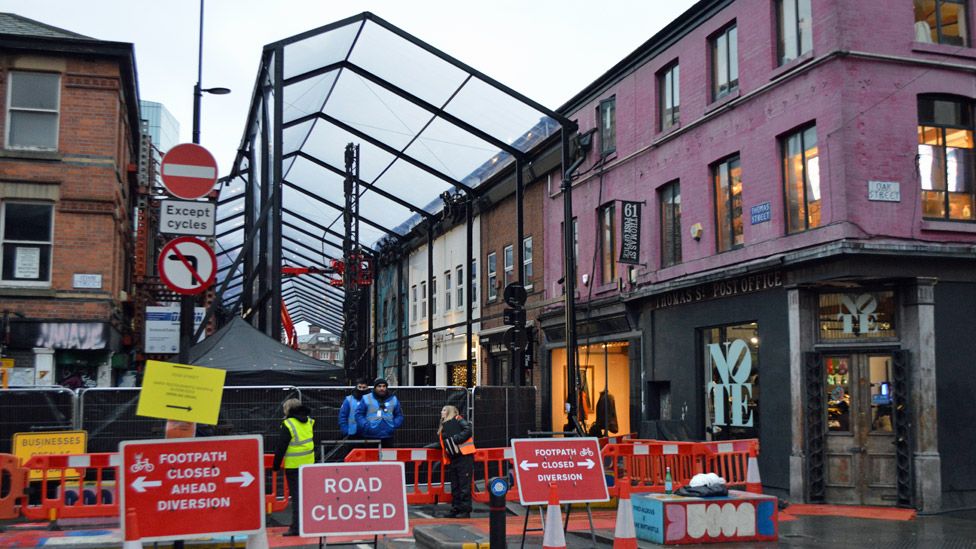
It seems that Manchester is the most creative city in the UK. According to the Greater Manchester Business Board, “Manchester is trading on its creative prowess to become an international powerhouse for the arts, creating new opportunities for residents in all sectors to forge lasting careers in this sector.” It is the UK’s “most inspiring city”, taking top spot and beating London into fourth place, behind Brighton and Bristol. Another win for Manchester!
Lists like this have been around for a couple of decades. Most notable was Richard Florida’s “Creative Class” data-set, where he went around the world “rating your city”, and, for a fee, would advise on how to rise up the table. Manchester won his “most Bohemian City” award in 2003, this time London being knocked into third place by well-known boho capital Leicester.
Florida’s metrics involved “gay-friendliness, ethnic diversity, and the number of patent applications per head of population”. As anyone who knew the city could see, the co-location of three large universities, the Gay Village and Rusholme and Mosside, in that thin slice of Greater Manchester officially known as “Manchester”, was skewing the stats. Why such a combination – a curry mile, a technology patent, a cluster of Gay bars – should be dubbed “bohemian” was a bigger mystery. But then, linking any contemporary economic success to the wild years of Manchester’s early music scene is the city’s own version of Steve Jobs and Bill Gates meeting in a North Californian garage.
Florida is an academic at least. This latest research was done by “Adobe” according to one report, but most credit “Auraprint”. I’m sure they can do you a great A1 spreadsheet but they are not best known for economic geography surveys. Their metrics are all related to creative arts infrastructure (numbers of theatres, art galleries, comedy clubs, art and design universities), social media hashtags (Insta, TikTok), and number of available creative arts jobs. A whole barrel full of mixed-up apples and oranges, clicks and bricks. How does one weigh numbers of theatres against a hashtag count? London has 90 billion Tik Tok hashtags. Manchester only 13 billion. Liverpool has 65 billion. What on earth do these figures mean? Dare one suggest that football might be involved?
And the thin slice of Manchester again works in its favour. I have no idea if they were methodologically rigorous enough to distinguish between a job in Media City (Salford) or in a creative cluster in Stockport, or just looked through the latest local arts job listing. For “Manchester” there were 148 jobs. Divide that by the population (550,000) and you get a score of 31.46 per hundred thousand. Easy. London has 873 jobs but that comes out as 9.95 per hundred thousand. So what exactly is “London” statistically – most likely Greater London (almost 9 million). Greater Manchester has a population of 2.8 million, and so has a jobs per 100,000 count of something like 6. Which would put it well below Bournemouth, Southampton and Nottingham, amongst others. The same could be said of numbers of theatres and galleries, where “Manchester” regularly – and unfeasibly – trounces London, but would rapidly drop down the table if measured as Greater Manchester.
This might not be entirely fair. Real statistical work has shown how deeply concentrated creative jobs are in Manchester, Salford and parts of Cheshire. How places like Bolton are almost entirely denuded of such jobs. But then, the same could be said of a sprawling London. Are we talking Islington and Whitechapel or Romford and Croydon? In reality, the number of creative jobs in the capital outstrips Greater Manchester by a factor of 8. Just as it outstrips Manchester on whatever socio-economic metric you want to name, other than social deprivation.
In short, best not to look at the stats too closely. But that’s never really a problem. Auraprint have got a bit of publicity. I clicked on the link to their table and was offered some really good printjob specials. Manchester’s booster machine can go into overdrive.
Manchester is already recognised as one of Europe’s largest creative, digital and technology clusters and is home to a fast-growing £5 billion digital ecosystem. The city’s thriving creative, digital and technology community includes over 10,000 businesses including the BBC, Brown Bag Films, Mediacom and Dentsu Aegis.
Well, again, best not look too closely. Or rather, set aside an afternoon to get under the bonnet of claims about “one of Europe’s largest”. And what exactly is a “£5 billion digital ecosystem”? Those highlighted firms are interesting too. The BBC is based in Salford. Brown Bag Films is a Canadian owned Irish CGI company that left the city in 2021. Mediacom is a US cable company that has its “northern headquarters” in the city. Dentsu is a “multinational media and digital marketing communications company headquartered in London, United Kingdom, and a wholly owned subsidiary of the Japanese advertising and public relations firm Dentsu”, according to Wikipedia.
Statistical sleight of hand aside, the claims here relate to Manchester offering a north of England home to some global media-tech companies, only one of which is actually home-grown, even though it is in Salford. What does this have to do with the density of creative arts infrastructure, design universities and arts jobs? This elision is a common trope of the “creative industries” schtick. Images of bright young things with cameras, or sweating in dance studios, taking their stage bows, or thrilling their audiences in an ecstasy of music making: all this somehow leads to one of “Europe’s largest creative, digital and technology clusters”. How exactly? This is variant of the Tony Wilson story, in which a “bunch of bands” Made Manchester Great Again, recently given an airing in Manchester Unspun.
Well, cities need their myths and their saints, why not this updated “original modern” version? In part because, like Liverpool used to be with The Beatles, “the tradition of all dead generations weighs like a nightmare on the brains of the living” – as a one-time regular visitor to Manchester once said. There was only one thing sadder than naming Manchester’s new iconic venue “Factory” and that was then selling the naming rights to an insurance company. Which makes sense. For the Tony Wilson Manchester story (as retold multiple times by Paul Morley) is one in which the creative arts move into the factories left by the departure of industry, mostly to China. Maybe. In the 1980s. But the new Aviva-Factory is surrounded by massive skyscrapers premised on victory of the classic FIRE establishment – finance, insurance and real estate. Not locally grown either but driven by sovereign wealth funds from Abu Dhabi. Manchester is now a rentier city.
Manchester’s creative arts sector – the bright young things that end up on the front of the glossy magazines, not the back-end coders in the finance company or the hard faced account managers at the marketing firms – the ones who make art in all its guises (and I include comedy), are not thriving. Forming barely 2 percent of the Greater Manchester work force, they are the inspirational pea lying deep beneath the glittering digital-tech cluster that is Manchester. They are living on low incomes with insecure jobs and are the most lumpen part of a professional middle class that is currently falling into the world of precarious wage labour. Their education is getting more expensive, their debts higher and the courses they did are being phased out as useless indulgences. As the Conservative government’s strategy of slowly bleeding out our local authorities reaches its death rattle, councils announce “100 percent cuts in the arts”.
Dave Moutrey, the city’s new Director of Culture talks of the middle class colonisation of the arts, a somewhat bizarre sociological observation by somebody who has been a major player in the arts since the late 1980s. How have he and his colleagues allowed this to happen? Yet the same article celebrates the arrival of the English National Opera, though who knows how it will be financed and just how the middle classes are to be kept out of it. This whole glittering artifice of Manchester Creative City is built on an ongoing extraction by marketing companies and their FIRE clientele from a creative arts aquifer for whose sustainable replenishment – as fossils fuel companies with the environment– they feel no compulsion to concern themselves with. It’s what Nancy Fraser called cannibal capitalism.
The degradation of the state education system, the collapse in public services, the erosion of the social and cultural infrastructures that occurred over the last decade have made their mark on the city. From its homelessness and rental stress, mental health crisis and transport chaos, to its ongoing democratic deficit vis-à-vis London and the FIRE elite which effectively control the city, Creative Manchester has its work cut out. Scapegoating some colonising middle class in the massive, ongoing land grab that is the Manchester real estate market is deeply misplaced, the anti-elitism of fools, to adapt a phrase.
Start investment in social and cultural infrastructure and nurture the small-scale local ecosystems of arts and culture. Treat them not as start-up enterprises requiring entrepreneurial business mentors but as part of our shared cultural foundations, respected for what they deliver to us, not as up-stream digital-tech clusters. Invest in creative arts programs as part of the life of the city not as economic development levers. And if art jobs are to be the objective, make sure they are secure, well-paid, and with clear career paths. Not a bunch of happy-go-lucky, bright-coloured all singing, all dancing, disposable Deliveroo drivers.
Make Manchester a creative capital.
 Justin O'Connor